WEBINAR
Automate anything:
Why a 7-axis arm matters
Learn how 7 axes built into a collaborative robot arm can reduce setups, fixturing and cell footprint.
Watch now
45 minutes, including live Q&A. Presented by Rod Martinez, Senior Engineer, and Brian Tran, Application Specialist. Originally presented as an Automation World webinar.
What's covered
Did you know the human arm has 7 axes (three at the shoulder, one at the elbow, three at the wrist)? Shop machines are designed around that arm. A 6-axis robot working in spaces built for 7 can encounter challenges that add time.
Basic demonstration of a 6-axis arm blocked by an obstacle that a 7-axis arm can easily work around
A Blaze welding demonstration navigating into a large pipe to weld the interior, a job a 6-axis arm would need to refixture for
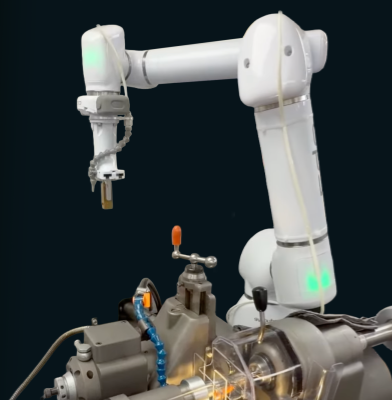
Two lathes tended by one OB7 in the 40-inch gap between them, with productivity up 20% and fewer dropped parts
Live no-code teaching demo, taught by hand and running in minutes
Q&A on payload, ISO 10218 and OSHA, welding power sources, machine integration, and multi-robot cells
Your speakers

Rod Martinez
Senior Engineer

Brian Tran
Application Specialist
Rod Martinez, Senior Engineer at Productive Robotics, is one of the inventors of OB7. He explains why the arm was designed with seven axes rather than six, and what the extra joint does across machine tending, multi-op work, and welding. Brian Tran, Application Specialist, works with shops to scope automation projects. He demonstrates the no-code teaching process live, start to finish.
OB7 and Blaze run in machine shops, weld cells, and general automation across North America, in 500+ installations. Having 7 axes built into the arm enables jobs that would otherwise need more setups or fixturing.